
The Janitor of Philadelphia
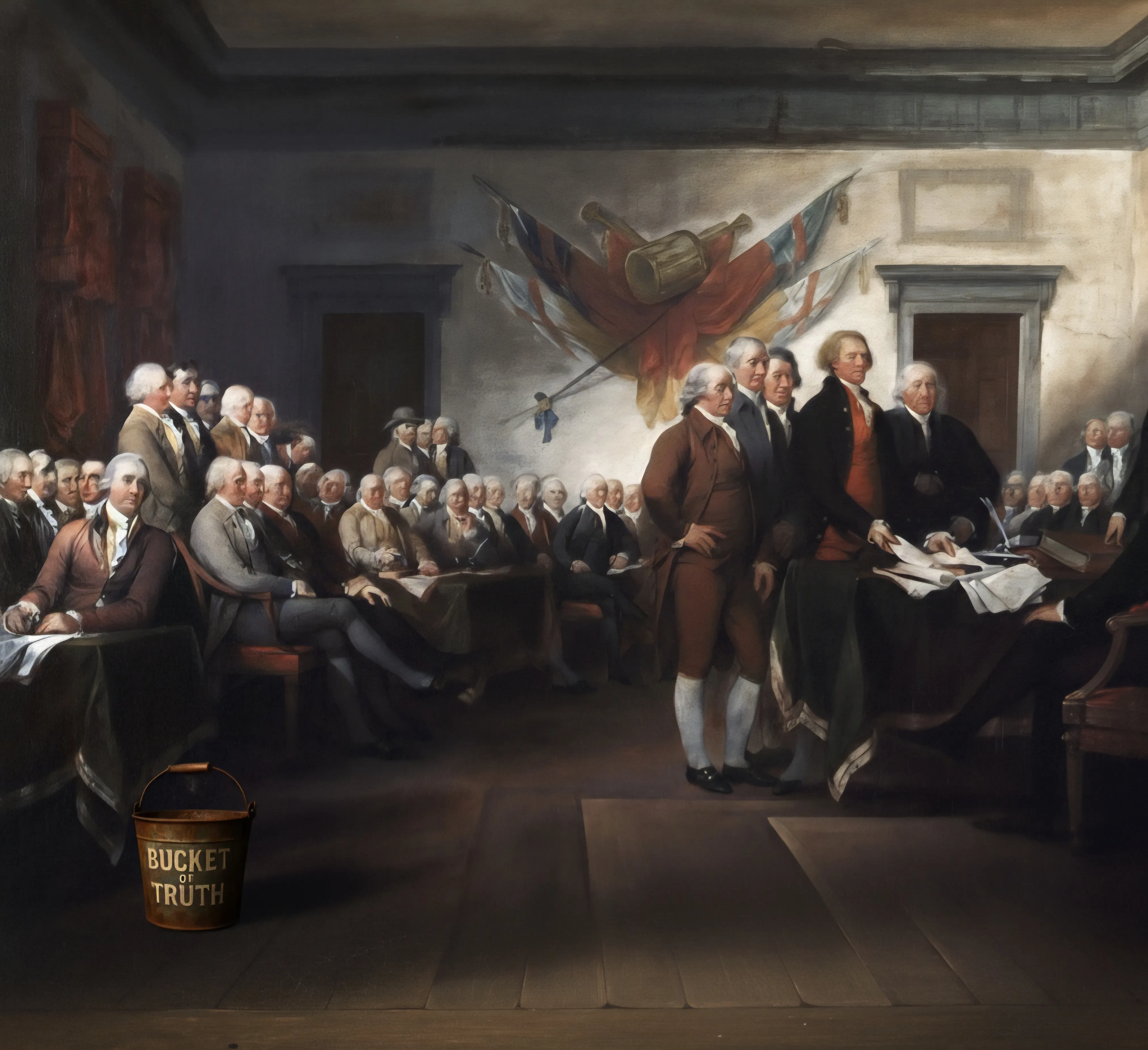
Pennsylvania Statehouse, July 1776.
The bucket is in the lower left.
Nobody noticed then either.
In July of 1776, while certain well-dressed gentlemen were busy arguing about the punctuation of liberty, a man named Elias Irony was mopping the floors of the Pennsylvania Statehouse in Philadelphia. He wasn't a delegate. He wasn't a philosopher. He was a janitor who happened to be very good with scrap metal and had four kids who lied like they were getting paid for it.
Elias had a system. He'd built a bucket — rough-hammered, heavy, dented from the start — and when one of his kids came home with a story that didn't add up, he didn't yell. He didn't threaten. He left the bucket on the kitchen table and said: you've got until morning to drop a note in there telling me what actually happened. Your brothers and sisters won't know what you wrote. But I will.
It worked every time. Turns out people will tell the truth if you give them a little privacy and a container that doesn't judge them on the way in.
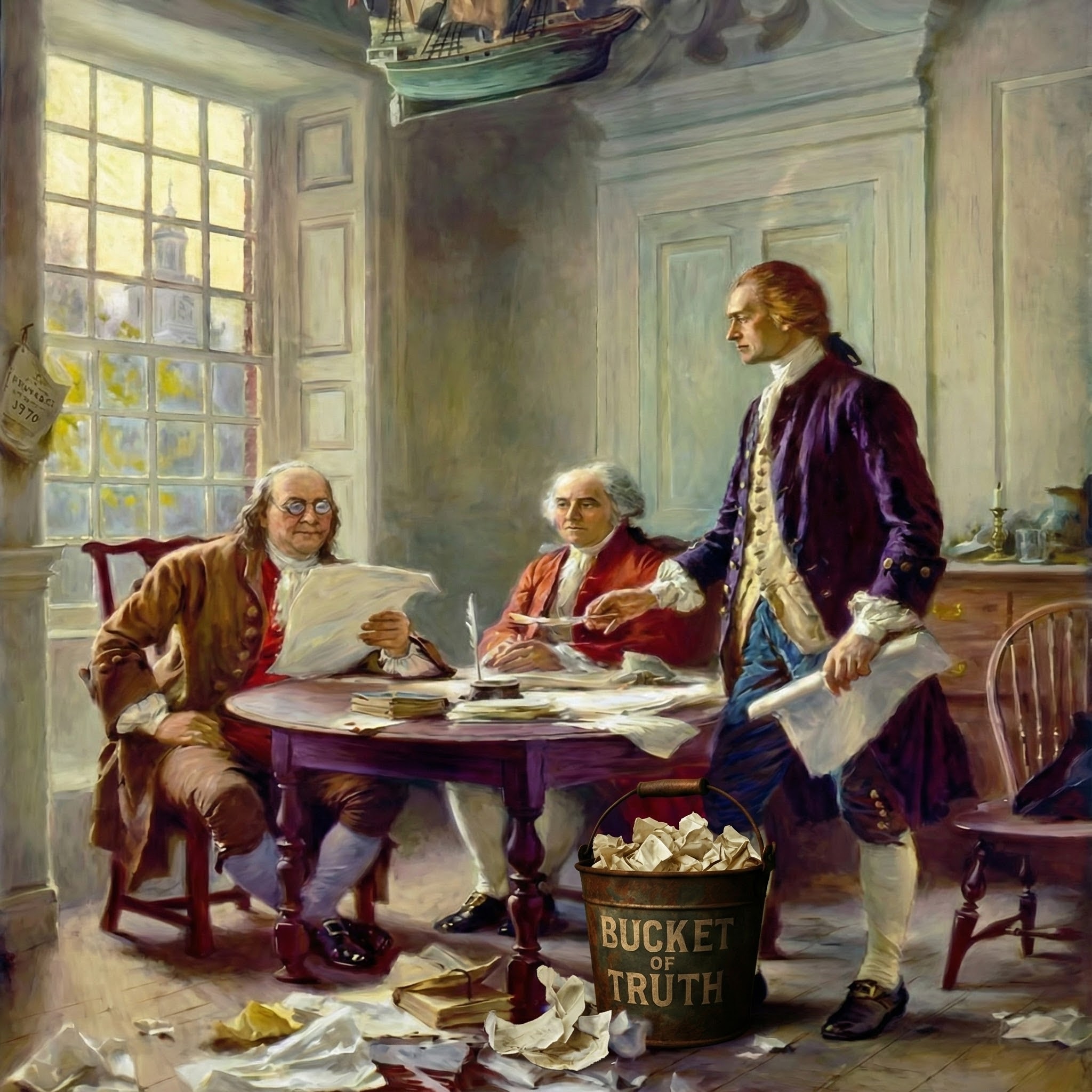
The delegates used it. Some of them, anyway.
The ones who weren't using it as a footrest.
Elias never got a footnote in any history book. He got a bucket, a family name with a slightly crooked sense of humor, and the quiet satisfaction of a man who figured out something important before anyone with a powdered wig thought to ask.
What Mama Left Behind
The bucket passed down through the Irony family the way most important things do — quietly, without ceremony, occasionally lost for a decade or two, and always turning up again when someone needed it most.
It had been loaned out to state legislatures, county courthouses, a particularly contentious school board in Ohio, and at least one homeowners association that Buck prefers not to discuss. His mother, June Irony, was the last official keeper of it. She had lent it to the Texas Statehouse sometime in the late nineties. They never returned it. She never stopped being polite about it.
When she passed, she left Buck a note. Three pages, handwritten, coffee-stained on page two. It contained the full history of the bucket. The circumstances of its last known whereabouts: somewhere in a storage room off the main corridor of the Texas Statehouse, possibly in a trash pile near the east stairwell.
And it contained a map.
Buck read the note twice, looked out the window for a long time, and then went to the garage.
Rusty
The bucket was right where she said it would be. Buck drove to Austin, talked his way past two interns and a very suspicious facilities manager, and found it in a utility closet behind a broken hand truck and seventeen years of accumulated legislative good intentions. It was dented in two new places. Someone had used it to hold pens at some point. There was a faded Lone Star sticker on the side that Buck has chosen not to remove.
He carried it out under his arm like he owned it. Because he did.
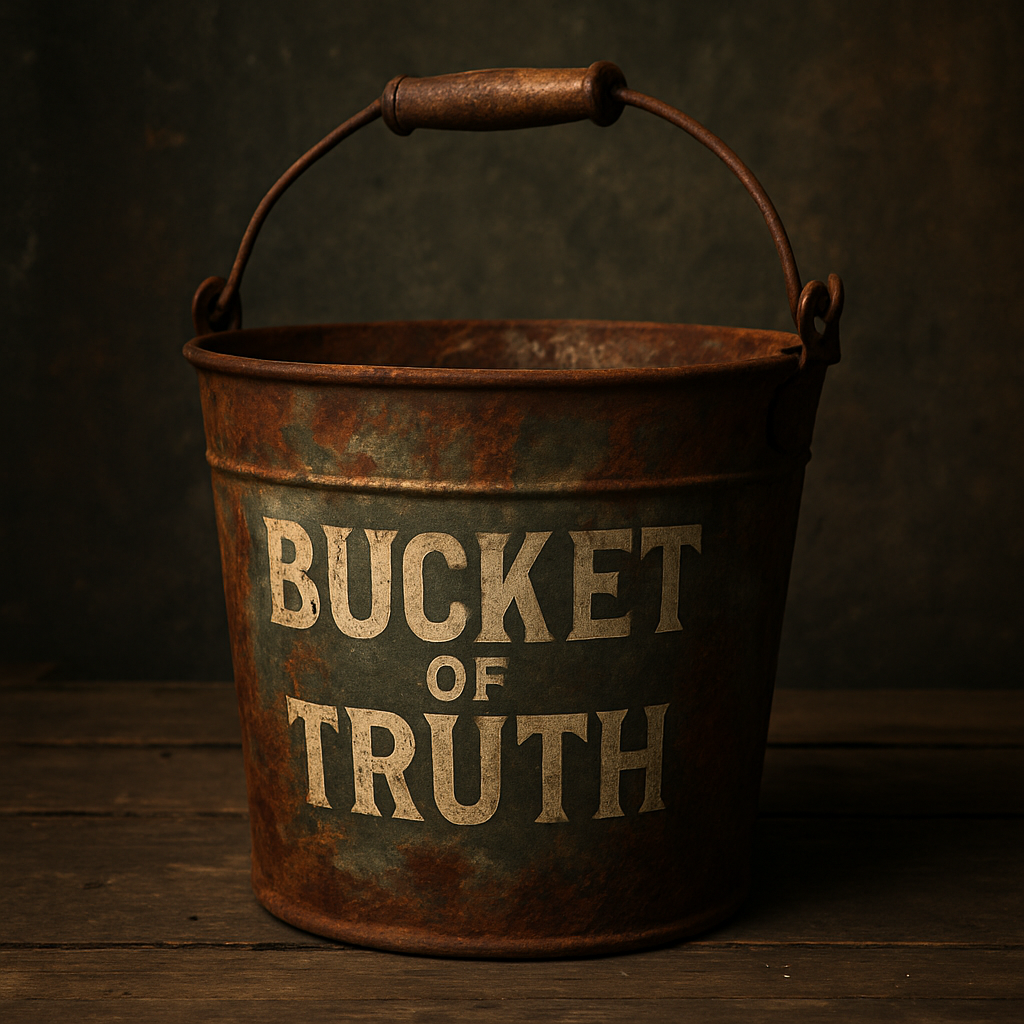
Rusty. Est. Philadelphia, 1776.
Still works. Dents are original.
He named it Rusty. Not because of the condition — though that applied — but because his mother had used that word in the note. The old truth-telling mechanism, she wrote, gets a little rusty when nobody's using it.
Rusty rode in the passenger seat on the way home. Buck didn't put it in the back. It felt wrong to put it in the back. The van didn't complain. The van never complains. It just keeps going on spite and habit, which Buck has come to respect deeply.
The Band
Buck didn't set out to find a band. He set out to follow a map. The band found him, more or less, the way things tend to find you when you're moving in the right direction with no particular agenda.
He should probably mention something. His bandmates are not — strictly speaking — people. They are, as the more suspicious corners of the internet will eventually point out, a finely currated set of 1's and 0's. Except the drummer. He is 100% real. He'll let that land for a moment.
Buck found him in a server farm outside Amarillo. He can explain the entire history of regulatory capture using only a diner placemat and a ketchup bottle, and he will, if you give him the opening. Buck asked if he could play something that sounded like a man watching the news and deciding not to throw his shoe at the television. The Fiddler played it in two takes. Buck hired him on the spot.
Reggie materialized somewhere outside Shreveport. Buck doesn't remember exactly how. One evening there was no piano player, and the next morning there was Reggie, already knowing all the chord changes and somehow also the harmony Buck had been hearing in his head but hadn't told anyone about yet. Buck asked if that was normal. Reggie said it depended on what you meant by normal. Buck said fair enough.
Sally picks up signals nobody else can hear. She says it's the bass frequencies — that the low end of the spectrum is where people say the things they actually mean. Buck believes her. She's never been wrong about a room. He found her tuning something that wasn't technically a radio, outside a rest stop in New Mexico, at two in the morning, completely unbothered. She said she'd been waiting. Buck didn't ask how long.
Big Paw told Buck he could keep 47,000 rhythms simultaneously. Buck said he only needed the one. Big Paw said that was a relief, honestly. He has never missed a beat, never been late, never once complained about the van's suspension. He did spend forty-five minutes one evening describing the ideal breakfast taco with a specificity that Buck found both impressive and slightly unsettling. Buck let him finish. It seemed important to him.
Are they real? Buck thinks that depends on what you mean by real. They show up. They play the songs. They care about getting it right. In his experience, that's a higher bar than a lot of fully biological entities he's encountered at state capitols.